
Side Car: Eric Simonson
My Brother the Filmmaker Talks About His New Documentary, "Going for Home."


My brother Eric—a director, playwright, screenwriter, filmmaker, festival founder and author based in Los Angeles—is always working on something. Usually, several somethings. And you’re never quite sure what’s the next project to shoot out of the pipeline. Recently, he casually mentioned he had finished a new documentary and asked if I would give it a look.
This was news. Because, among his many accomplishments, Eric won an Oscar back in 2005 for the short documentary A Note of Triumph: The Golden Age of Norman Corwin, about the famed radio artist of the 1930s and 1940s. Five years earlier, he had been nominated for an Oscar for the short documentary, On Tiptoe: Gentle Steps to Freedom, about the South African musical group Ladysmith Black Mambazo. So the arrival of a new documentary by him was something of note.
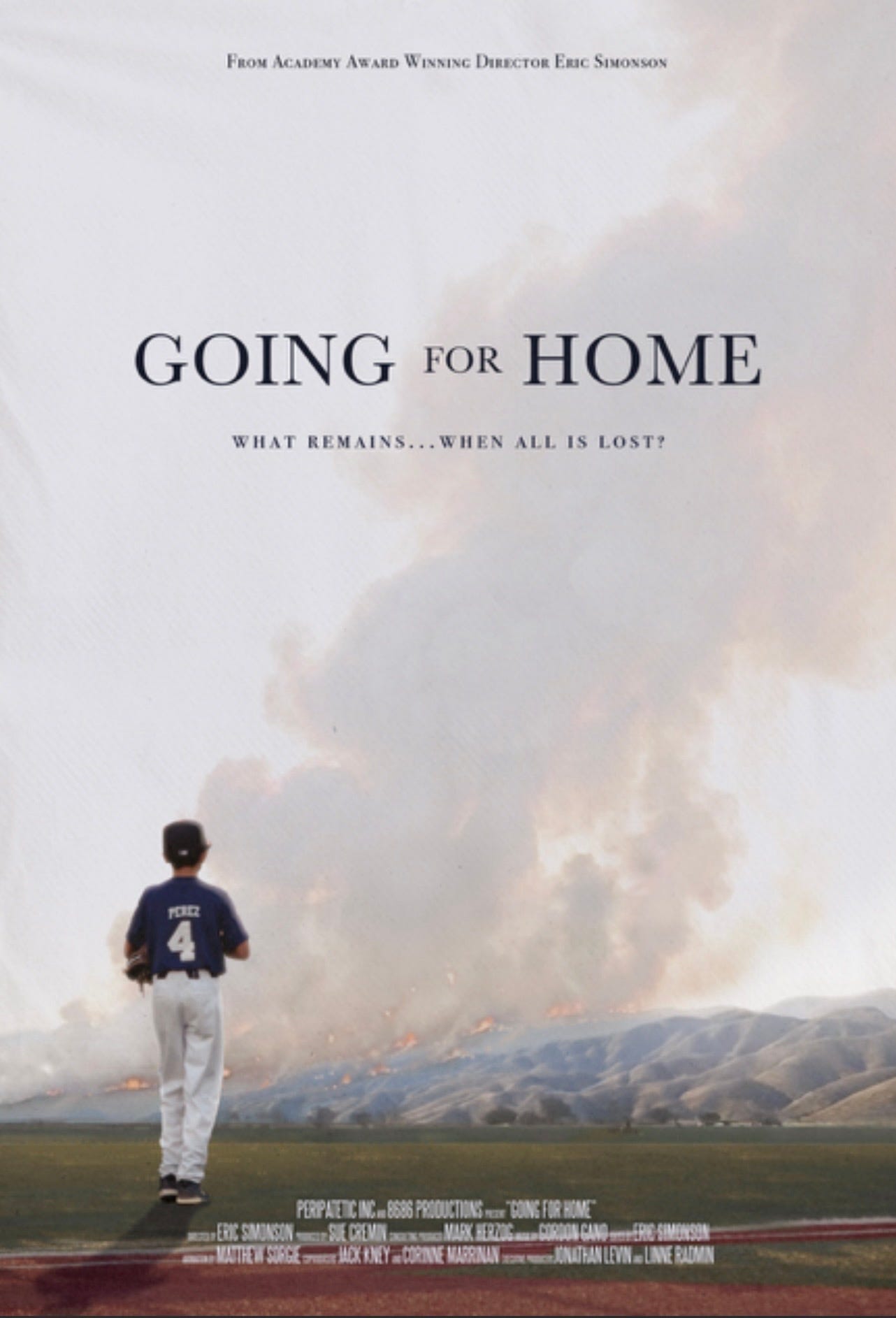
The new work, called Going for Home, strikes rather closer to home for Eric than those previous works. It concerns the Central Altadena Little League, from near his home in Glendale, CA, which picked up and carried on with its season, even after the devastating Eaton Canyon fire left many of the involved families displaced. The project was a family affair, with Eric’s wife, actress Sue Cremin, and son Henry Simonson pitching in.
The Mix spoke to Eric shortly before Going for Home had its premiere at the Santa Barbara International Film Festival. The conversation is below.
THE MIX: How did the idea for this film come about?
ES: I live in Glendale, which is very close to Altadena. My son, Henry, went to school in Altadena and played on the Little League there while he was growing up, so we have lots of friends in the community. The Eaton Canyon fire affected us in a real way—we didn’t lose anything but knew many who had. When my wife, Sue, and I heard that the Central Altadena Little League was going to be going ahead with their season despite the fact that between 60% and 90 % of the families there had lost their homes, we thought immediately this would make an interesting story. I grabbed a camera and we started shooting.
THE MIX: How long after the fires did you start filming it?
ES: We began shooting on opening day, which was March 1st, 2025, so that was about 7 weeks after the fires.

THE MIX: How did you choose who to talk to?
ES: We talked to anyone who would talk with us. We didn’t know which families or players were going to emerge as contenders, and we had to get everyone’s story regarding the fire, which took tons of time. There are over 200 players in the league, which means 200 whole families. As we continued to shoot, some stories stood out more than others, and we started to see which teams were having the most interesting seasons. It really was a slow process of winnowing down to our key subjects.
THE MIX: Did you know some of the people in the film before you started this project? Did your son Henry know any of the kids?
ES: Henry’s a sophomore in college now, so he didn’t know any of the kids, but there were at least three coaches he knew from his days playing, and these coaches remembered Henry, who actually worked on the film as an assistant editor and PA. So he got a chance to reunite with some of his former coaches.
THE MIX: Was it difficult interviewing the kids?
ES: In a word, yes. A lot of kids wanted to be interviewed, but when they got in front of of the camera, they froze, and all their answers tended to be “Yes,” “No” or “I don’t know.” But we shot a lot of film, and we were around a lot. They got used to us and we were able to cobble together enough footage to get a dimensional look at some of these kids. And they are fascinating.
THE MIX: What was the hardest part of making Going for Home?
ES: Finding a home for the film. Many buyers today won’t even look at it because it’s not True Crime, which is about 90% of what’s being distributed these days. Places like Netflix and Amazon over-bought a few years back, when they were looking for content to beef up their libraries. They’ve put the brakes on that the past couple years, so the market is tough. And we need to think about getting the film out ; there in more creative ways.
ES: It's been 21 years since you won an Oscar for A Note of Triumph and 17 years since your Studs Terkel documentary. Why did it take so long for you to make another documentary?
I came from theater, and after a few years doing docs, I realized, “Hey, this is just like doing theater: you work really hard and get paid practically nothing for it.” So I moved over to writing for television, which is just as fun, but pays a living wage. Also, I never start a documentary from the question, ”What should be my next subject?” I only ever started a doc when I was inspired to make one. And that’s what happened with Going for Home. The opportunity presented itself, and I had a feeling it would be a good story. So I acted on it.
THE MIX: How did you get Gordon Gano of The Violent Femmes to compose the soundtrack?
ES: I sent him the film and he responded to it. I think Gordon has this natural proclivity to support story with his music, which at its essence is very pure and spare. I thought it would be a good match for the film.

THE MIX: The film just had its premiere at the Santa Barbara International Film Festival. What was the reaction?
ES: By now, I’ve seen the film about one-hundred times, but always by myself or with Sue. This was the first time I’d seen it with an audience and I was surprised by how vocal the reactions were. There were lots of big laughs, and some very audible sobs. I don’t think I could have asked for a better reaction.
If you want to see Going for Home, it will have a second and final screening at the Santa Barbara International Film Festival on Feb. 14 at 6 p.m. Tickets are available here.
Odds and Ends…
Phil Ward of Long Island Bar is up to his usual Martini-mixing tricks. During a recent visit to the bar, we were treated to not one, but two new Martini variations. The first was the Nordic Gibson, made partly the aquavit and garnished with a cocktail onion and a celery ribbon—notable, in that Ward almost never bothers with garnishes. The second was called the Birthday Martini (by us), because it was Mary Kate’s birthday on the night in question. It was a simple mixture of Hayman’s gin, plus both dry and blanc vermouths… Holiday, the later Richard Greenberg’s modern-day adaptation of Philip Barry’s 1928 play, opened Feb. 9 at the Goodman Theater in Chicago, which is currently celebrating its centennial. Look for a review of the production, directed by Robert Falls, on The Milwaukee Mix in the days to come… Achilles Heel, the remote cocktail bar opened by Andrew Tarlow in Greenpoint, Brooklyn, has closed after 13 years in business… It was a bad week for music. Greg Brown, the original guitarist for the band Cake and the composer of their song “The Distance” died on Feb. 7 at the age of 56. And Fred Smith, the original bassist for Blondie, who later joined the group Television, dies on Feb. 5 at the age of 77… Sfingi season has arrived in Brooklyn. The special Italian pastries, which commemorate St. Joseph’s Day, are now available at Court Pastry Shop… On The Milwaukee Mix last week, I wrote about the amusing and mysterious history of Hamdingers, a ham product produced by Patrick Cudahy in the 1970s and 1980s… The British pop group Squeeze will release a new album on March 6. It is a collection of songs that songwriters Chris Difford and Glenn Tilbrook wrote when they were teenagers, years before they found fame. It will be called Trixies, and the songs are a collection of stories set in a fictional night club… F & F Pizzeria, the popular Brooklyn pizza parlor, will open a Manhattan location at Shaver Food Hall, inside the former Lord & Taylor department store.
Bar Shot: Old Hillside Harlem Hellfighters Bourbon

Featured on the Simonson/Murray home bar this week is Old Hillside Harlem Hellfighters Bourbon. It is a limited-edition Bourbon from the North Carolina-based, Black-owned Old Hillside Bourbon Company, released in honor of Black History Month. It pays tribute to the 369th Infantry Regiment and African-American soldiers of World War I.
“This partnership isn’t just about whiskey. It’s about honoring a legacy of valor, sacrifice, and resilience,” said Jesse Carpenter, chief product officer of Old Hillside Bourbon. “The Harlem Hellfighters fought longer and harder than nearly any American unit in WWI, and this collaboration allows us to preserve their story while supporting veterans who continue to serve today.” The unit was awarded a Congressional Gold Medal in 2025.
The whiskey was finished in French oak, Pinot Noir wine barrels for 191 days, and bottled at 55% abv. These choices weren’t random. 191 is the exact number of days the regiment spent on the front lines in France. The barrels themselves originate from the same region where the Hellfighters fought. Only 150 cases will be released across three unique commemorative labels.
Old Hillside Harlem Hellfighters is a robust Bourbon, yet complex in flavor, with toasty barrel notes and sweet red-fruit notes coming through equally. The influence of the wine barrels is not overwhelming, hanging in the background and lending a touch of subdued elegance to the dram. Probably best enjoyed on its own, we did nonetheless made some very successful Manhattans with it.
This is quite a film - I wish I was nearby, so I could see it on the big screen!
Great interview! 👏👏👏❣️